pre:Invent 2026 - Betting on Kiro & KiroCrew and what it means
Kiro has evolved in 2026 - with new capabilities, apps and integrations
If you’re reading this article you probably know that I am pretty interested in “DevTools” in general and that I’ve been watching this space since I started my journey in the AWS community a few years ago (back then mostly with Amazon CodeCatalyst).
In 2025 there as a shift from Amazon Q (Developer and others) towards moving a lot of what is happening in this space towards the Kiro brand. As most of you might know, there are nowadays different possibilities to interact with Kiro, so it becomes hard and difficult to say what Kiro really is. The space of “AI development tools” is evolving at light-speed and even if the Kiro team is not at light-speed like others (Codex, Ampt, Claude Code) the team is at least at 0.75*light-speed and it’s difficult to keep up with that pace.
in this article I am trying to give an overview of where we are in 2026, right before AWS re:Invent 2026. I expect this article to be (partly) outdated when I am on my way back.
What Kiro is and means for me in 2026
Kiro is for me my “hosted harness” - my hopefully soon enterprise ready Harness where I can ideate, code, chat and operate my applications and services. On the device I want (laptop, computer, mobile, tablet, TV, …) and with the UI that I want (web, cli, app). It is my “simple” way of running short and long coding sessions.
Kiro is my interface to the model I want and need.
Kiro is the something that “just works” and allows me to be more productive as a single developer building things.
How the approach of “too many apps” can be explained
Massimo wrote about this a few months ago: Kiro is an interface that gives you access to a lot of capabilities and options.
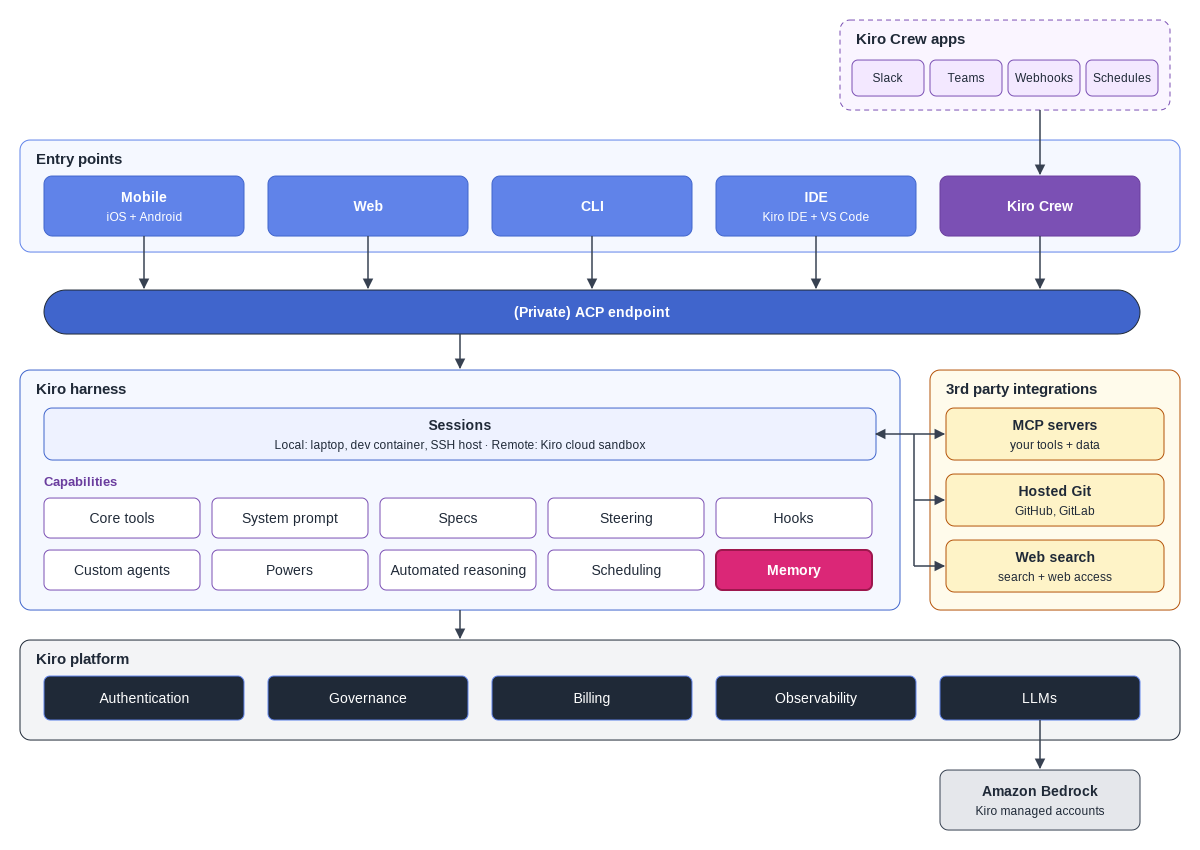
This diagram is built on top of the one that Massimo had shared in this blog - it goes a bit further and adds some additional things that he’s not added. It also shows how big the Kiro ecosystem has become. It doesn’t clearly articulate the possibility to run sessions as “local” sessions or “remote” sessions.
To answer the question above in short: You get full flexibility to choose the UI / App that you want to access the hosted Kiro backend. That hosted Kiro backend gives you an opinionated access to the LLMs.
If you use Kiro Auto Mode, you get an automated pick for the AI model that is used for the different tasks. If you choose to pick your model, you get access to a variety of models - nearly all of the ones that are available on AWS Bedrock.
This flexibility is somethign that sets Kiro appart form other options.
What the Kiro team is also doing
Sciecnce and leadership
The team behind Kiro has recently started to post a lot of information around the “internals” of Kiro and Kiro Crew, around the facts of how Kiro is building Kiro itself and about the research that goes into taking the appropiate decisions of what to build in the future.
I’ve linked a few articles below, but the articles about “Frontier Teams” and “Frontier Engineering” show how much the team cares about also enhancing software development in general.
Other examples are the post on Kirobench an internal benchmark that was built inside AWS to verify Kiro’s performance before releasing changes.
The Kiro Blog as a bunch of more articles focused on research.
Gearing up for the enterprise
We have also seen that the team has invested a lot on required enterprise capabilities:
- ISO/IEC 27001:2022
- Cloud sessions in private networks
- Better enterprise sign-in controls
- Credit pooling
Also recent updates to the website look more “enterprise-ready” than they where before: Kiro Crew LTS, a new onboarding tutorial, Kiro Enterprise Management and other pages.
Gosh, there is even a new “Kiro Governance Language” on the website!
There is way more for me to do and read - but it looks like enterprise customers are a target for the Kiro team vs. the current “students”, “builders” and “startups”.
I’m excited to see what re:Invent 2026 will bring for us :-)
Most recent announcements that are relevant and ground breaking to me
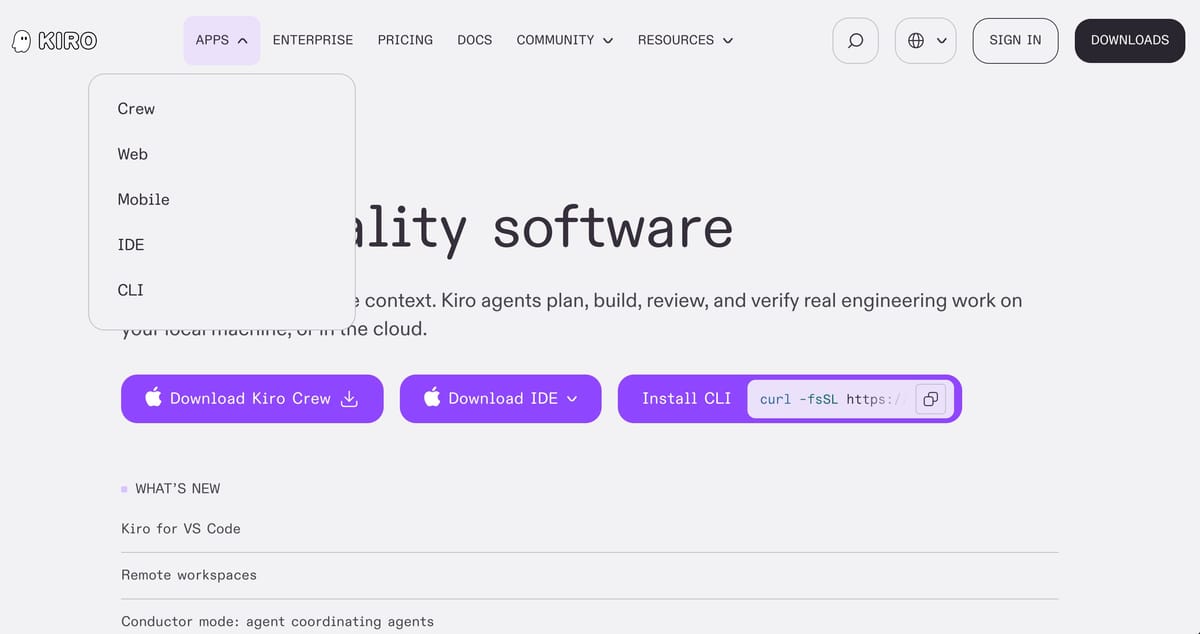
- Nov 20, 2026 - Remote workspaces: Kiro IDE can now open cloud sessions, run inside dev containers and connect to your own machines over SSH, so the full IDE works wherever your code and compute live.
- Nov 20, 2026 - Kiro for VS Code: Kiro is now a native extension for VS Code (macOS, Windows, Linux). It reads the same
.kirofolder as Kiro IDE, so specs and steering work in both. - Nov 20, 2026 - Conductor mode in Kiro Crew: A conductor agent takes a goal, splits it into tasks for worker agents and tracks progress on one board. It sits between a single chat and a long-running bot.
- Nov 12, 2026 - Kiro for Android: Start, steer and review cloud sessions (including diffs and PRs) from your phone. Kiro for iOS is available too, but there was no announcement for it.
- Nov 10, 2026 - Approve for me: An LLM review auto-approves routine actions, blocks unsafe ones and only asks you when it is unsure. This is a middle path between approving everything by hand and trust-all-tools.
- Nov 4, 2026 - Credit pooling: Kiro Enterprise teams share one pool of credits, with per-user limits, alerts and billing through AWS.
- Oct 20, 2026 - Memory in Kiro IDE and CLI: Kiro can remember your preferences, repo conventions and corrections across sessions. It is off by default and stays local to your machine.
What’s I still think Kiro needs
Overall I think Kiro has done huge steps in 2026. New functions, new capabilities, new interfaces.
When I look at the diagram above there are a few things that at least for me stand out in “missing”, especially for enterprises:
- The possibility to run inference within your own AWS Account (through Bedrock) or the possibility to add other providers for inference
- The possibility to run the Kiro sessions (the compute!) on my own AWS account and potentially my own, hardened base images
- Team and collaboration features
Besides those - and I could write more requirements and thoughts down - Kiro today doesn’t full cover the “end to end” SDLC processes - no workflows, no security tooling and integrations, etc. AWS has move of those capabilities already (eg by using CodePipeline, CodeBuild, etc.) … but … so much open things… And that’s where Kiro will potentially look closer to CodeCatalyst in the future than it is today :-)
I’ll leave you with this, let’s see what re:Invent 2026 brings and how this continues. What Harness or hosted Agent solution are you using right now?
I’d love to hear — reach out to me on LinkedIn or through my contact form.