

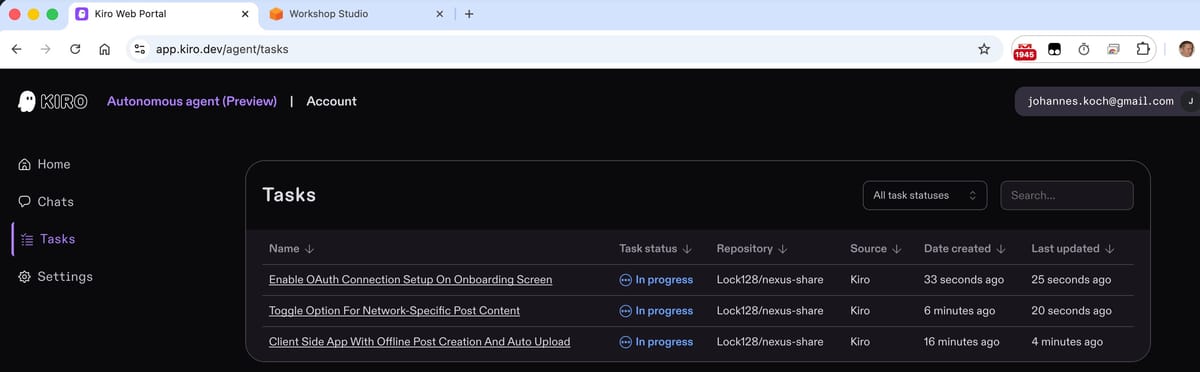
A mobile UI for Kiro Autonomous Agent (KAA)
A big bang and then…
At re:invent 2025 (more than 3 months ago!) the AWS team announced Kiro autonomous agent. Since then the AWS team has been receiving feedback, getting more and more customers like me to try out the capabilities. They have added the option to add “Context” to all of the agents’ sessions, they have re-vamped and implmented the backend, and they have made a new UI available.
However, one of my personal main use cases has always been to be able to access, control and interact with the Kiro Autonomous Agent (KAA) from my mobile phone.
Ideas don’t spark at your desk…
…ideas spark in your free time, when you are out in the wild and enjoying the nature. When you are comuting or doing house-work.
That’s where, in the new development era of agentic AI assisted coding, it becomes important to be able to access your “new friend” whenever and any time you want. Bin able to be productive, becomes an essential component of delivering value to production environments.
So, accessing your agents from the phone helps builders to generate value whenever they want.
One of my first requests to the KAA team…
When I learned about KAA, one of my first request to the team was to enable and allow accessing the agent from my phone.
Unfortunately, as of today, the UI is still unusable.
Given I’m a builder and curious person, and given I’ve been experimenting with Flutter, I used Kiro (IDE) to create a mobile application for iOS and Android that you can use to access the agent:
It was created by Kiro within less than three hours.
It works and I open sourced it here: kiro-mobile
How i built it and how authentication works
I used Kiro spec based development to create this spec and then asked Kiro to “implement all tasks”.
A few hours later (I think it was about 2 hours), I had the skeleton of a working app. It needed another few vibes (10-20) to remove the build errors and to test out the first API calls.
Another 10, including some HAR from accessing the “AWS hosted web app” in my browser and I was able to access KAA in a “Flutter web app” running on my local device.
Authentication works in a way that it uses the OAuth redirect (that the official web app uses), asks you to login there and then grabs the Bearer token in the background, stores it and uses that to do authenticated API calls against the Backend API that the “official” webapp provides.
The app in action: KAA Mobile UI
Bringing it to App and Play Store
As a next step, I wanted to make sure that I can make the app available to users on their mobile, Android and iOS, devices.
Flutter makes this simple: without any code changes you get feature parity on multiple platforms.
However, the difficult part is to get the app into the Apple App Store and into the Play Store - I haven’t found a Skill and/or MCP server that does that for me so it took my some time to set up my Codemagic build correctly and set up the applications.
But now the app is available to test in both app stores. If you’re interested to test it (it requires you to have a Kiro Autonomous Agent account!), please reach out to me on socials or through the contact form.
As I just learned, it seems to only work using the AWS Builder ID login right now.
For iOS I do have a public beta link.
So, what do we learn from this?
- It’s becoming too simple to “reverse-engineer” applications
- three months in “agentic coding” right now is more than a decade
- AI will not replace humans as “integration work” still needs us and not agents
I’d like to add some thoughts especially on point number 2:
Kiro is a brand which is seggregated from the AWS ecosystem - but as most of you know, the team behind Kiro - CLI, IDE and KAA - lives within the AWS and Amazon Ecosystem.
From the outside, it feels like this team is moving like the “death star” and not like a “X-Wing” like Codex, Claude Code & Cowork and OpenCode. Or even Ona . Or Tempo.
I don’t think much will happen in 2026. But 2027 will be the year of waking up and of consolidation in this space.
What do you think who will “survive”?
What is YOUR favourite agentic coding system right now?